
Laparoscopic vs Open Gynaecological Surgery: Which Is Right for You?
When surgery is recommended for a gynaecological condition such as uterine fibroids, an ovarian cyst or heavy menstrual bleeding, one of the first questions you may have is: Will I need open surgery, or can it be performed laparoscopically?
It is a reasonable concern. You may be thinking about pain, recovery time, hospital stay and how soon you can return to your daily routine.
Both laparoscopic and open surgery are established approaches used to treat gynaecological conditions. However, they differ in how the surgeon accesses the pelvic organs. Understanding these differences can help you have a more informed conversation with your gynaecologist about the most appropriate treatment for your condition.
What Is Laparoscopic Gynaecological Surgery?
Laparoscopic surgery, commonly known as keyhole surgery, is a minimally invasive technique that uses small incisions in the abdomen. A thin instrument with a camera, called a laparoscope, allows the surgeon to view the pelvic organs on a screen while operating with specialised instruments.
Depending on the diagnosis, laparoscopic surgery may be used for procedures such as uterine fibroid removal (myomectomy), hysterectomy, removal of selected ovarian cysts and treatment of endometriosis.
Because the incisions are smaller than those generally required for open surgery, this approach may result in less postoperative pain, smaller scars and a shorter hospital stay in suitable cases.
However, laparoscopic surgery is not appropriate for every patient. The size and location of the condition, the complexity of the procedure and other individual factors all influence whether this approach is suitable.
What Is Open Gynaecological Surgery?
Open surgery involves making a larger incision in the abdomen to provide direct access to the pelvic organs. The location and size of the incision depend on the procedure and the patient’s anatomy.
Although laparoscopic techniques are used for many gynaecological procedures, open surgery continues to play an important role in treatment.
For example, a woman with multiple large fibroids, significant pelvic scar tissue or a complex condition may require an open approach. It may also be preferred when the surgeon determines that direct access would allow the procedure to be performed more safely.
The choice is not simply between a modern technique and an outdated one. Both approaches have specific indications, and the priority is to select the method that best addresses the patient’s condition.
Laparoscopic vs Open Surgery: What Are the Key Differences?
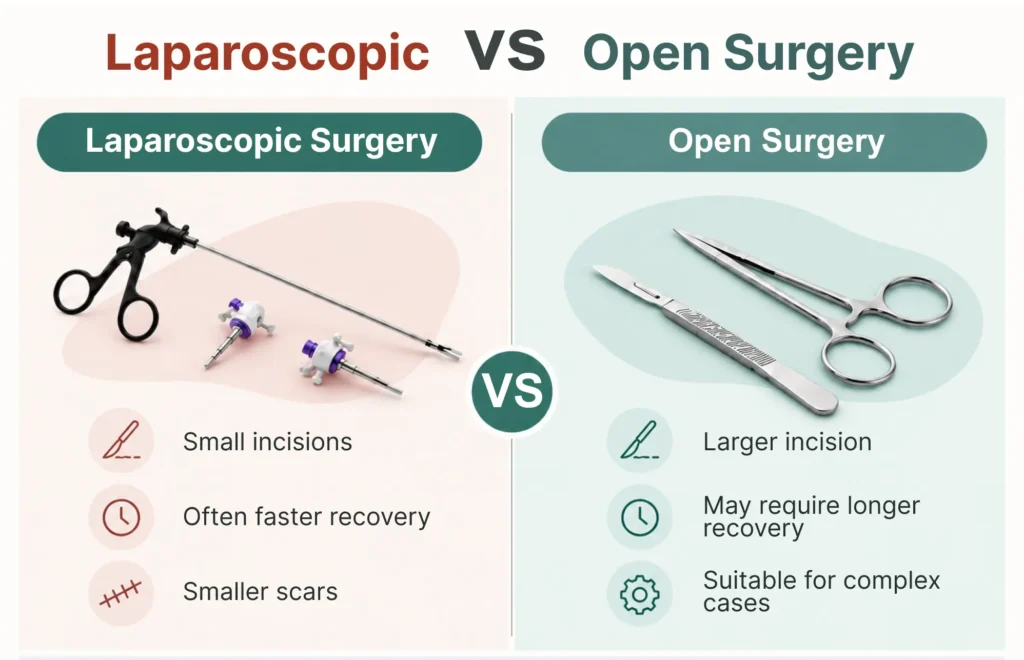
The main differences relate to the surgical incision, recovery and the circumstances in which each approach may be appropriate.
Incision size: Laparoscopic surgery generally involves several small incisions, whereas open surgery requires a larger abdominal incision.
Postoperative pain: Patients may experience less pain after laparoscopic surgery than after comparable open procedures, although individual experiences vary.
Hospital stay: Laparoscopic procedures often allow an earlier discharge, depending on the operation and the patient’s recovery.
Scarring: Smaller incisions typically result in less visible scarring, although healing varies between individuals.
Suitability: Laparoscopic surgery may be appropriate for many conditions, while open surgery may be necessary for certain complex procedures or when minimally invasive access is unsuitable.
These are general differences, not guarantees. The type of surgery, the extent of the condition and the patient’s overall health all influence the outcome.
What Does Recovery Look Like?
Imagine two women undergoing surgery for different gynaecological conditions. One has a relatively straightforward ovarian cyst that can be removed laparoscopically. The other has multiple large fibroids requiring a more complex operation.
Their recovery experiences may be very different, even if both procedures address problems affecting the same part of the body.
Laparoscopic surgery often allows patients to resume everyday activities sooner because it involves smaller incisions. Open surgery may require a longer recovery period because the abdominal incision involves more tissue healing.
However, recovery depends on more than the surgical technique alone.
Factors that can influence healing include:
- Type and extent of surgery: More complex procedures may require additional recovery time.
- General health: Existing medical conditions can affect healing and postoperative care.
- Pain management: Following the prescribed pain-relief plan can help you remain comfortable during recovery.
- Postoperative care: Wound care, appropriate movement and following medical advice support recovery.
Your surgeon can explain the expected hospital stay, activity restrictions and likely timeline for returning to work and other daily activities.
When Might Open Surgery Be Recommended?
Despite the potential benefits of laparoscopic surgery, open surgery may be more appropriate in certain circumstances.
These can include particularly large or numerous fibroids, a significantly enlarged uterus, extensive scar tissue from previous operations or a condition requiring a specific approach to remove abnormal tissue safely.
In some cases, surgery may begin laparoscopically but need to be converted to an open procedure if unexpected findings arise or continuing with the original approach would be unsafe.
Conversion does not automatically mean that something has gone wrong. It may be a necessary clinical decision made to prioritise patient safety.
Your surgeon should explain the possibility of conversion when discussing the planned procedure, where relevant.
How Does a Gynaecologist Choose the Right Approach?
There is no single surgical method that is best for every woman. The decision depends on several clinical and personal considerations.
Your gynaecologist will assess your diagnosis, symptoms and examination findings. Imaging investigations, such as ultrasound or MRI when indicated, can help establish the size, location and characteristics of the condition.
Your medical history, previous abdominal or pelvic surgeries and any existing health conditions may also influence the choice.
Your treatment goals matter, too. If you wish to preserve your uterus or maintain the possibility of pregnancy, these preferences should be discussed alongside the medical considerations.
Finally, the complexity of the procedure, the surgeon’s experience with the relevant technique and the available facilities help determine the most appropriate approach.
Dr. Nivedita Kaul, gynaecologist in Delhi NCR, can assess these factors and discuss the potential benefits, limitations and risks of the available surgical options based on your individual circumstances.

 WhatsApp